
Blog Category: Academics
Adedayo Akinwale and Sunday Ehigiator
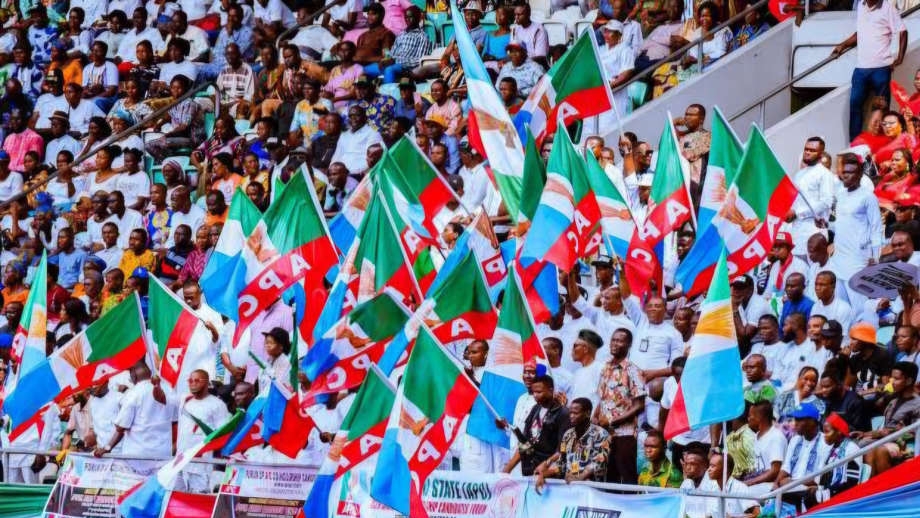
The Federal Capital Territory (FCT) was a beehive of activities from yesterday till the early hours of today as the ruling All Progressives Congress (APC) held its 8th National Convention with a total of 8,453 delegates electing new national officers of the party.
The event went beyond routine party ritual to reflect the deeper state of the country’s democracy. With the presence of President Bola Tinubu, the gathering was seen as both a consolidation of power and an early rehearsal for the 2027 general elections.
To fully understand the significance of the moment, it is important to situate party conventions within Nigeria’s political history.
For instance, in the First Republic, parties such as the Northern People’s Congress, Action Group, and National Council of Nigerian Citizens operated conventions and congresses that were deeply influenced by regional, ethnic, and ideological alignments. While these gatherings provided platforms for leadership selection and policy articulation, they were also arenas of intense rivalry that sometimes deepened divisions within the fragile federation.
Since the return to civilian rule in 1999, conventions have remained central to Nigeria’s democratic architecture. Parties like the Peoples Democratic Party (PDP) institutionalised large-scale conventions that brought together delegates from across the country.
These gatherings helped legitimise leadership and maintain party cohesion, especially during the PDP’s long period of dominance. However, they also allegedly became synonymous with delegate inducement, imposition of candidates, and the growing influence of political godfathers.
The emergence of the APC in 2013, as a coalition of opposition forces raised hopes for a different model of internal democracy. The current ruling party came into being following the merger of opposition parties. The political parties that metamorphosed into APC included the Congress of Progressive Change (CPC), Action Congress of Nigeria (ACN), a faction of the All Progressives Grand Alliance (APGA), the New Peoples Democratic Party (nPDP) and the All Nigerians Peoples Party (ANPP).
Its early conventions were seen as relatively competitive and reflective of its diverse origins.
Following the merger, the inaugural convention of the party was held in December, 2014, at Teslim Balogun Stadium. The convention saw the late Muhammadu Buhari emerge as the presidential candidate for the 2015 general election. The second convention was held in Lagos at the same venue.
The third was a mini convention held in Abuja 2016, while in 2018, the ruling party held an elective convention in Abuja, which was aimed at restructuring and stabilising the party’s internal leadership.
Similarly, in 2022, the party held another elective convention at Eagle Square, in Abuja. The convention was crucial in managing leadership transitions and producing the party’s presidential candidate.
However, the repeal of the Electoral Act, 2022 and the enactment of the Electoral Act, 2026, introduced adjustments to statutory timelines governing pre-election and electoral activities.
It was against this backdrop that the Independent National Electoral Commission (INEC) reviewed and realigned the Schedule to ensure full compliance with the new legal framework.
Declaring yesterday’s convention open, the National Convention Central Coordination Committee Chairman and former Governor of Katsina State, Hon. Aminu Bello Masari said the convention was not a routine jugglery, but a solemn assembly, a historic moment, and a powerful reminder of the strength of the country’s democracy.
He noted that it was at the convention they would affirm their values, renew their commitments, and chart the path for our party and our country.
The former Speaker of the House of Representatives stressed that the APC was built on conviction, sustained by sacrifice, and strengthened by the loyalty of millions of Nigerians who believe in the promise of progress, justice, and unity.
Masari said: “APC has always strengthened our unity, and today, as we gather to elect our new leaders, we are reminded—we remind ourselves—that leadership is not about privilege; it is about service. It is not about titles; it is about trust. It is not about power; it is about unity.
“It is about trust. It is not about power; it is about unity. It is about unity. It is about responsibility.
“Delegates, the same responsibility you carry today is immense. You are not here merely to cast a vote. You are here to shape history.
“The decisions you make will echo far beyond this convention hall. They will influence the direction of our party, the confidence of our members, and the destiny of our nation.
“Conduct yourselves with dignity, fairness, and discipline. Let this convention be remembered not only for its outcomes but for the integrity of its process.”
Masari. acknowledged the challenges confronting the nation — insecurity, economic pressures, inequality, and social divisions.
However, for yesterday, accessing the Eagle Square, the venue of APC national convention was a tough task. Security agencies cordoned off the road leading to the venue. While VIPs were allowed to drive through, journalists were at the mercy of thugs mobilised to the venue by the politicians. The thugs later overrun the ruling party’s convention ground when they forced their way through.
For obvious reasons, the leadership of the party decided to err on the side of caution and refused to rock the boat at this convention by allowing most of the current members of the National Working Committee (NWC) to contest and return unopposed through a consensus arrangement.
The reason for this is not far-fetched. The ruling party was not ready to allow the party to be engulfed in any intractable crisis ahead of the 2027 elections.
Nevertheless, the Deputy National Organising Secretary of the party, Nze Chidi Duru, dismissed the perception that the decision to allow most of the NWC members to contest without opposition turned convention to coronation party.
He noted, “I would like to say that it is majorly consensus. It also underpins the basic tenet for which APC is known. As much as possible, building a consensus, bringing people together behind the scene, working harder to ensure that there is no rupture and there is no implosion, as people would like to have it.
“It does not mean that there are no contests. It doesn’t mean that there are no disagreements. But once the party has the internal mechanism, there can only be one person that occupies an office, it cannot be two, and if it is two, it makes it a lot easier.”
Based on this, the National Chairman of the party, Nentawe Yilwatda, National Secretary, Ajibola Basiru, Deputy National Chairman (North), Hon. Abubakar Dalori (Borno); Deputy National Secretary: Prof. Abdulkarim Kana (Nasarawa) were returned unopposed.
Other national party officers elected were: National Vice Chairman (North Central), Mu’azu Rijau (Niger); Deputy Vice Chairman (North East), Dr. Mustapha Salihu (Adamawa); National Vice Chairman (North West); Hon. Mohammed Datti (Kaduna); National Vice Chairman (South East); Dr Ijeomah Arodiogbu (Imo), National Vice Chairman (South South), Hon. Victor Giadom (Rivers).
Similarly, the National Vice Chairman (South West), Isaac Kekemeke (Ondo); National Legal Adviser, Muritala Kankia (Katsina); National Treasurer: Uguru Ofoke (Ebonyi); Deputy National Organising Secretary, Hon. Nze Duru, among others, were elected.
The Deputy Senate President, Jibrin Barau moved the motion for the extension of Caretaker committees at ward, local government and levels in Osun and Ekiti states, while the motion was decided by Senate Leader, Opeyemi Bamidele.
While most of the opposition parties are still battling with internal crisis, and some still struggling to find their footing, less than one year to the general election, the ruling party has continued to set the pace.
While the party seeks to avoid divisive contests that could weaken its electoral chances, the heavy reliance on consensus risks alienating members who feel excluded as we saw recently.
This pattern is not unique to the APC; it cuts across Nigeria’s political spectrum, including opposition parties and one of the factors that affected the PDP. The result is a political system where elections may be competitive, but internal party democracy remains fragile.
For Nigeria to move toward a more robust democracy, political parties must move beyond personality-driven politics that offer voters little real choice.
Ultimately, as the country looks ahead to 2027, the real challenge is not only about winning elections but about transforming political parties into institutions that genuinely embody democratic values. Without that shift, conventions will remain impressive in scale but limited in substance, leaving the foundations of Nigeria’s democracy weaker than they ought to be.






0 comment(s)
Leave a Comment