 Author: CSCS, T+1 settlement is nice to have, but is it what the market actually needs?. Posted On: 13 hours ago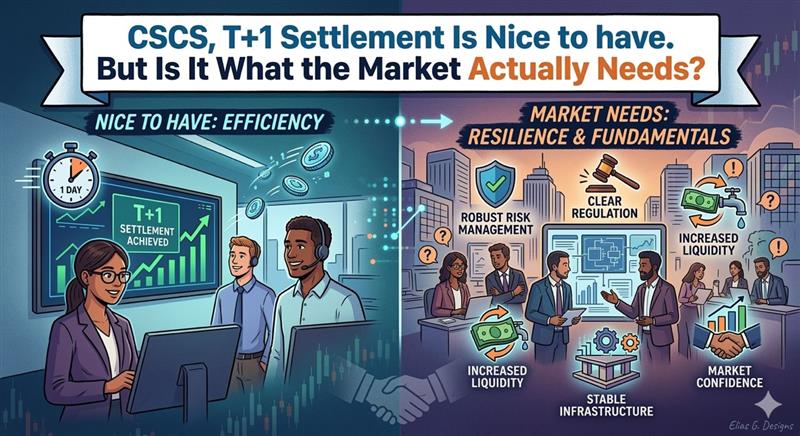
Blog Category: Academics
There is an old leadership maxim worth revisiting: activity is not the same thing as progress.
Busy hands and meaningful outcomes are not synonyms, and the finest leaders understand the difference between motion and momentum.
They know how to stack priorities, protect attention, and spend organisational capital on problems whose solutions actually move the needle.
So when CSCS issued its circular this week announcing the transition to T+1 settlement effective 29 May 2026, the instinctive reaction from institutional participants was not applause. It was something closer to a raised eyebrow and a quiet mutter: ” Is this the hill we’re planting the flag on?
To be clear, T+1 is not a bad thing. Reducing settlement risk, compressing counterparty exposure, and signalling alignment with global best practice are all legitimate ambitions.
The Nigerian capital market deserves infrastructure that does not embarrass it on a global roadshow. But there is a pecking order to reform, and right now, the market’s most pressing operational pain points remain stubbornly unresolved. The fear among participants is not that T+1 is wrong; it is that CSCS might rush to launch something shiny and accidentally break something load-bearing in the process.
That would be very on-brand for a market that has a habit of solving for optics before solving for function.
In a market that is open for 4.30 hours, unblocking shares still takes up to thirty minutes and sometimes more. Let that sit for a moment.
A material portion of the trading session can evaporate before a participant can even execute. Speed of settlement is irrelevant if the front-end mechanics are grinding at dial-up pace. Fix the plumbing before you redesign the bathroom.
The minimum trade value rule is a blunt instrument that has long outlived whatever rationale originally birthed it. It excludes retail participation, restricts price discovery, and creates artificial friction in a market that is already thin.
A capital market that aspires to depth and breadth cannot sustain rules that functionally operate as a cover charge at the door. Remove it.
This one deserves more attention than it typically receives. Nigeria operates a dark auction with no data feed during the five-minute uncrossing window. Participants are essentially placing bets without being able to see where the market is likely to clear.
That is not an auction; it is a guessing game. Transparent pre-opening and closing auction mechanics with a live indicative price feed are standard in markets we benchmark ourselves against. There is no defensible reason for this information vacuum to persist.
Between NGX and the SEC, market participants are absorbing sixty basis points in transaction costs. In a market competing for international capital against peers who are actively reducing friction, it is a structural deterrent. The aggregate fee burden needs a serious review, and the conversation should be happening at the level of both regulators simultaneously, not in isolation.
Institutional investors managing multiple mandates need post-trade allocation to work cleanly, quickly, and with system-level support.
The current state of affairs requires levels of manual intervention that are inconsistent with the operational expectations of global asset managers. If Nigeria wants those managers to allocate meaningfully to NGX-listed equities, the post-trade experience cannot feel like a fax machine in a 5G world.
The participants who matter most to this market’s long-term development, the institutional investors, the foreign portfolio managers, the custodians processing large volumes quietly behind the scenes, did not wake up this week energised by T+1.
They woke up with the same list of operational grievances they have been carrying for years. And they have a quiet, reasonable concern that an organisation spending energy on the headline reform might not have enough left over for the structural ones.
Leadership is about ruthless prioritisation. It is about having the discipline to ask, before launching anything: is this the most valuable thing we could be doing right now? For CSCS, NGX, and the SEC, the answer in this cycle should have been a resounding focus on market microstructure, fee compression, auction transparency, and post-trade efficiency. T+1 can share the agenda. It just should not own it. The market is watching, and it is capable of counting.






0 comment(s)
Leave a Comment