 Author: Exchange rate disparity widens on speculation, dollar supply constraints. Posted On: 15 hours ago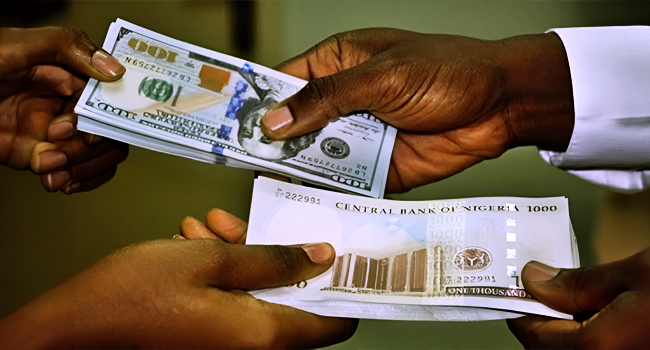
Blog Category: Academics
Exchange rate disparity between the official and parallel markets has widened amid rising speculative activity and dollar supply constraints in the economy.
Analysts who spoke to Nairametrics linked the development to increased demand pressures and limited access to foreign exchange at the official window.
The growing gap has renewed concerns about liquidity, policy implementation, and the potential for arbitrage in the foreign exchange market.
Recall that in April 2025, the President of the Association of Bureau De Change Operators of Nigeria (ABCON), Aminu Gwadebe, while commending the Central Bank of Nigeria (CBN) for the reforms in the forex market, revealed that in some cases the exchange rate for the dollar in the parallel market is cheaper than that at the official window, the first time in 15 minutes.
The exchange rate traded at N1,368.5/$1 at the official market and N1,390/$1 at the black market, representing a widening N21.50 disparity.
This follows an earlier period in August 2025 when the rate stood at N1,538/$1 at the official market and N1,550/$1 at the parallel market, showing a N12 gap. Market watchers say the increasing divergence reflects both speculative positioning and structural supply challenges in the system.
A former Director General of the Lagos Chamber of Commerce and Industry and founder/Chief Executive Officer of the Centre for the Promotion of Public Enterprise,Dr. Muda Yusuf, attributed the disparity partly to speculation. He explained that not all market participants are convinced that the naira’s recent appreciation will be sustained.
Offering further insight, a Bureau De Change operator, Umar Cindo, said supply, access, and confidence issues are central to the widening gap.
Their views suggest that both speculative activity and structural liquidity challenges are fueling the growing divergence between the two markets.
Yusuf further explained that increased political activities ahead of the general elections could also be exerting pressure on the parallel market. He noted that politicians often prefer to hold funds in dollars rather than naira during election seasons.
Cindo also cited delays and uncertainty surrounding policy implementation and the disbursement of forex allocations by the Central Bank of Nigeria as key drivers of the disparity.
He added that the wider the gap becomes, the more attractive arbitrage opportunities appear for speculators, encouraging round-tripping and further distorting the system.
Cindo maintained that to reduce the disparity, the CBN must restore liquidity and confidence through consistent and adequate supply of foreign exchange, transparent clearing of outstanding FX obligations, and a more unified and transparent exchange rate framework. He also noted that improving market transparency, enforcing regulatory oversight, and increasing dollar allocation to Bureau De Change operators could help improve liquidity and narrow the gap.
In April 2025, the ABCON President, Aminu Gwadebe, admitted that the naira was appreciating faster than expected against the United States dollar. He acknowledged that speculation, which had previously destabilised the market, had reduced significantly at the time.
In a related development, the naira depreciated steadily at the official market during the preceding week, coinciding with the 304th Monetary Policy Committee meeting of the CBN.
According to a Nairametrics review of official data published on the CBN website, the naira opened the week at N1,353.5/$ and depreciated in subsequent sessions, closing at N1,368.5/$. Market liquidity conditions and investor expectations have continued to influence exchange rate movements in the aftermath of MPC meetings.





0 comment(s)
Leave a Comment