
Blog Category: Academics
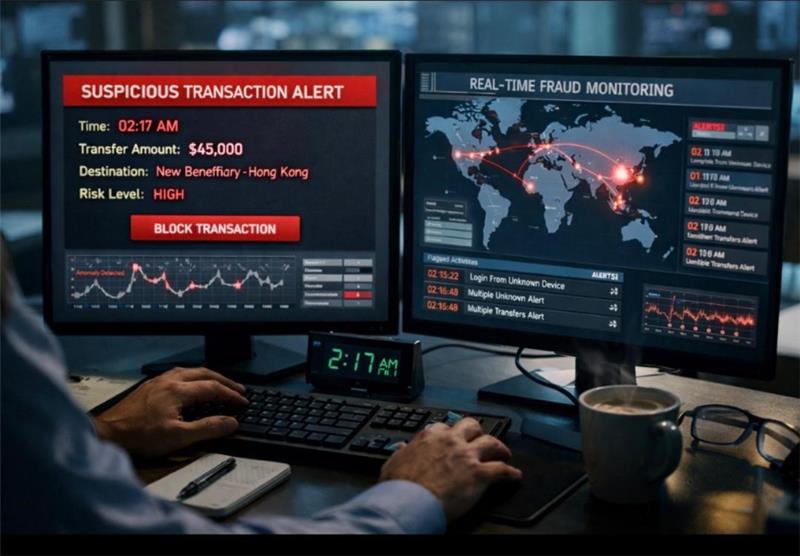
I have seen fraud happen in minutes, often at a time when most people believe nothing is happening.
Anyone who has worked within compliance, anti money laundering, or financial crime prevention understands this pattern.
Fraud does not wait for business hours.
In many cases, it deliberately avoids them.
Some of the most successful fraud incidents occur late at night or in the early hours of the morning. These are periods when attention is lower, escalation is slower, and operational coverage is limited.
In practical terms, this is what it looks like:
By the time teams resume full operations in the morning, the funds have already been dispersed. That is the reality institutions are dealing with today.
There is a critical distinction that must be understood. Detecting fraud is not the same as stopping fraud.
Detection without speed simply means reporting what has already happened. Real-time transaction monitoring changes that. It allows institutions to act while the transaction is still in motion.
From experience, there have been situations where:
In those moments, a delay of seconds prevented losses that would have been extremely difficult to recover.
This is where real-time monitoring becomes more than a compliance requirement. It becomes a core financial control.
Nigeria’s financial ecosystem has expanded rapidly, driven by fintech innovation, mobile payments, and increased digital adoption.
While this growth is positive, it has also increased exposure to financial crime.
Data from Nigeria Inter-Bank Settlement System (NIBSS) and regulatory insights from the Central Bank of Nigeria (CBN) continue to highlight rising fraud attempts across digital channels.
At the enforcement level, the Economic and Financial Crimes Commission (EFCC) frequently reports cases involving:
Many of these incidents follow a similar pattern. They occur during periods of reduced monitoring intensity. Fraud Is Not Random. It Is Timed.
One of the biggest misconceptions about fraud is that it is purely opportunistic. In reality, it is often calculated.
Fraudsters study systems. They understand:
This explains why high-risk transactions often occur during odd hours. This is not coincidence. It is strategy.






0 comment(s)
Leave a Comment