 Author: SPECIAL REPORT: Farmers, fishermen suffer as oil spills persist in Niger Delta communities. Posted On: 3 months, 1 week ago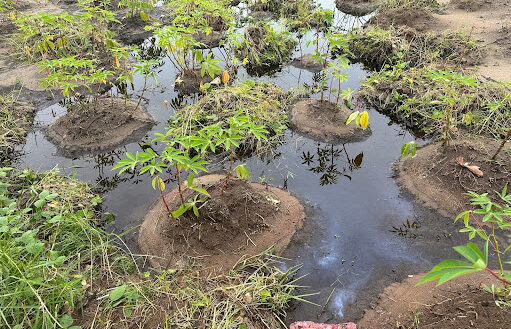
Blog Category: Academics
On 6 May, a Trans Niger Delta pipeline carrying crude oil burst at B-Dere, a community in the Gokana Local Government Area of Rivers State. The incident forced Daniel Kpoobari-Bani, his wife, and their four children to leave their home quickly to escape the flammable oil gushing out of the ruptured pipeline a few metres away from their front door.
The oil spread into many homes and farmlands in the community.
“My compound was affected by the leakage,” Mr Kpoobari-Bani narrated to PREMIUM TIMES during a visit to the community at the time. “We have been in discomfort since the incident occurred.”
Workers from the Shell oil company stopped the spillage on 15 May. This reporter observed as two tanker trucks sucked up the oil with long hoses as a humming bulldozer cleared a pathway for them. Armed soldiers stood at strategic positions as residents gathered to watch the operation.
Before the arrival of the workers, residents were scooping up the flowing oil into buckets and jerrycans. The air was thick with the choking odour of crude oil. Cooking became hazardous due to the risk of explosion, forcing many residents to relocate from their homes.
Before the workers fixed the ruptured pipeline, PREMIUM TIMES observed that the soil and crops in the surrounding farmlands had absorbed the crude content, and the environment was polluted.
The leaflets and pseudostems of cassava, cocoyam, banana, and plantain—a major staple crop grown by community residents—looked greasy and dripped with oil. Some residents who scooped up the crude oil had hidden it in the crop fields.
“Shell needs to relocate us from here,” Mr Kpoobari-Bani told PREMIUM TIMES, recalling a similar leakage two years earlier. “Crude oil has destroyed our crops, and we can no longer drink the water from our wells.”
The residents of Ogoniland and other oil-producing areas in Rivers State have a history of protesting against the deleterious impacts of oil production on their natural environment and livelihoods. Their protests have occasionally been met with repression by the government.
In the 1950s, Nigeria discovered crude oil in commercial quantities, eventually becoming the 15th-largest crude oil producerglobally and the largest in Africa. Oil exploration and production in the country have predominantly been in the Niger Delta region.
However, many oil-rich communities, such as Ogoniland, suffer hydrocarbon pollution. Many residents whose primary occupations are crop farming and fishing can no longer access farmlands and water, due to continuous oil leaks from creeks and pipelines.
The May spillage in B-Dere was one of the latest episodes of environmental degradation in Ogoniland. Extensive fossil fuel pollution has been recorded in the area over the past three decades, forcing the Nigerian government and the relevant stakeholders to initiate a $1 billion cleanup and restoration programme in 2018. The programme followed a comprehensive study conducted by the United Nations Environment Programme in 2011.
The remediation/restoration effort is being carried out by the Hydrocarbon Pollution Remediation Project (HYPREP), an agency of the government domiciled at the Federal Ministry of Environment.
However, the impact of the cleanup initiative remains largely negligible, as major oil pipelines traversing these communities frequently leak, resulting in spills that continue to harm the environment.
HYPREP did not respond to an email sent to the designated address on its website for comments on our findings.
However, according to data published by the National Oil Spill Detection and Response Agency (NOSDRA)—a Nigerian government agency monitoring oil spills—over 9,890 incidents were documented across Nigeria between 2015 and July 2025.
The data reveals that the highest number of spillages occurred in 2023 (1,518), but the highest volume of crude spill was in 2015 (nearly 56,000 barrels). NOSDRA’s oil spill monitoring report states that Rivers State recorded the most spills with 4,184 incidents, followed by Bayelsa (2,118), and Delta, Akwa Ibom, and Imo with 1,589, 399, and 272 cases, respectively.
The data attributes the predominant cause of oil spills to sabotage. Other significant causes include corrosion and equipment failures.






0 comment(s)
Leave a Comment