 Author: SPECIAL REPORT: In Lagos communities, flooding forces women into unsafe births. Posted On: 5 days, 17 hours ago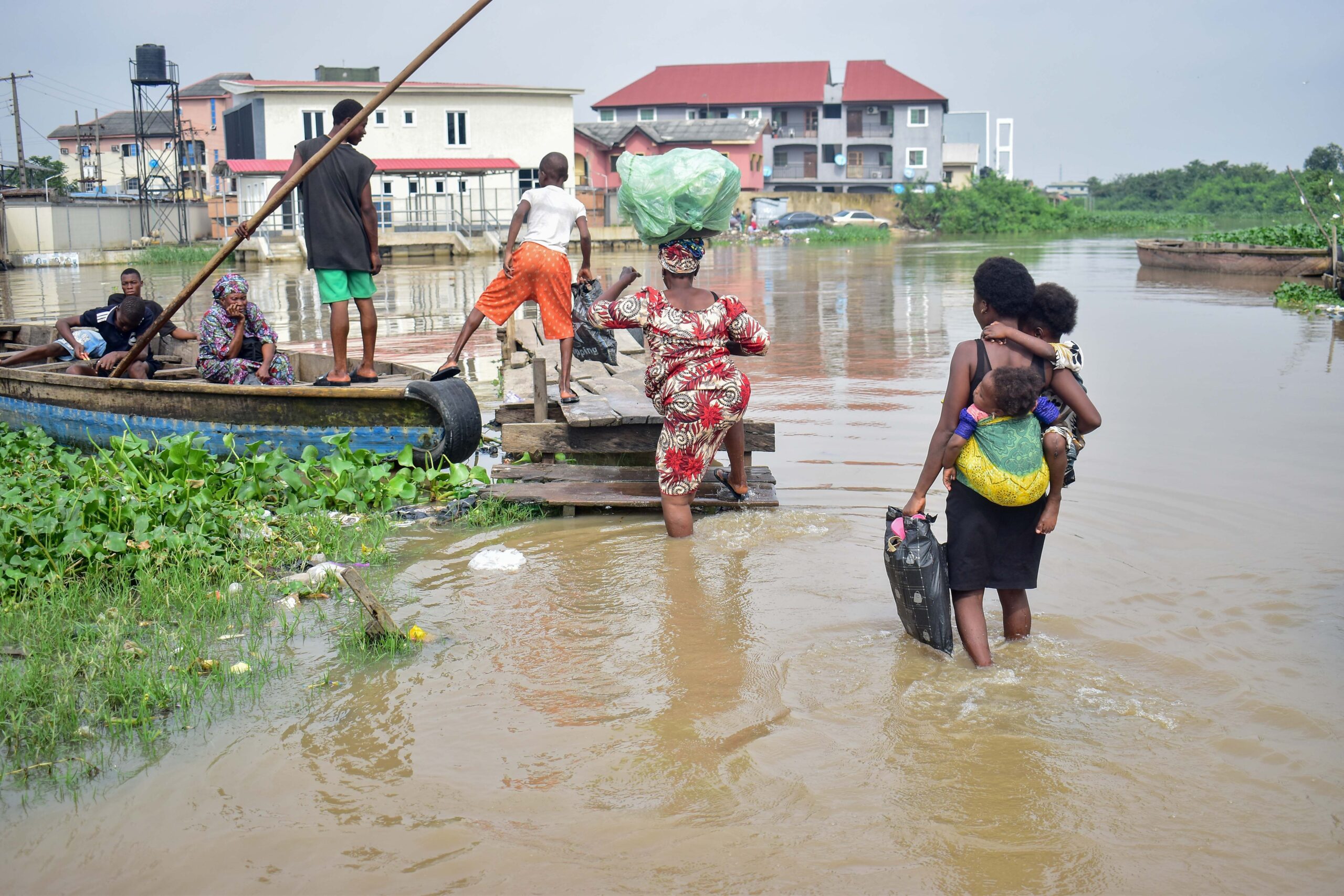
Blog Category: Academics
Fatima Sulaimon, 35, had her fifth child on a tiny fishing canoe. It happened in the dead of night, five years ago, in Agboyi, a riverine community under the Kosofe Local Government Area of Lagos State.
Agboyi comprises three main areas: Agboyi I, II, and III, all of which are surrounded by the Lagos Lagoon. The settlement suffers severe flooding not just during heavy rains but also when water levels rise or when excess water is released from the Oyan River Dam in Ogun State.
When these waters surge, the streets turn into a dark, impassable lagoon. The only way to reach the mainland is by canoe or boat. When PREMIUM TIMES visited the community on 11 October, this reporter had to navigate the flooded streets wearing high rubber boots, confirming the residents’ daily struggles.
This was the barrier Mrs Sulaimon faced that night.
When her labour started around 11 p.m., she was already at the home of a local nurse who served as the community’s birth attendant, a necessity in Agboyi, where hospitals are miles away and primary health centres barely function.
“But the labour became difficult,” she recalled. “The nurse was scared and said she couldn’t handle it.”
Her family began searching desperately for a boat. “They eventually got a fishing canoe to help at 1 a.m.,” she said softly.
As the small canoe rocked on the dark water, Mrs Suleimon struggled through her contractions and delivered the baby herself.
They turned back because the hospital was still far away, leaving the nurse to clean up and remove the placenta.
“If not for the flooding in the streets, it would have been easier. Because everywhere was flooded, we couldn’t get anything,” Mrs Sulaimon said.
Accessing immediate specialised care is a challenge for pregnant women in an environment where rising waters turn homes and streets into extensions of the lagoon.
“For an unconscious pregnant woman that we need to rush out for an emergency, we have to look for canoe or boat drivers. This is time-consuming,” said Taibat Salako, a nurse who has served in the Agboyi community for over 15 years.
She recalled a case in May of a woman who died after flooding delayed her transfer to a hospital.
“She had given birth but was bleeding. From 6 a.m., struggling to keep her alive, we arrived at Gbagada by 9 a.m., and she had already given up,” she said.
The Agboyi riverbank to Gbagada General Hospital is about a 20-minute drive.
Elizabeth Ajamobe, another nurse in the community, said when a woman is in labour and complications arise, they immediately ask her to “find a way out of here.”
The constant inundation has forced residents to live in perpetual adaptation, using crates or kegs to raise their belongings.
“For someone who is in labour and is walking gently, it is quite difficult to adapt,” Fatimoh Adetoyi, a resident of Agboyi, said. “Some women give birth on the small walkways we constructed, some give birth inside the boat. We have had cases where we were the ones to rescue them.”






0 comment(s)
Leave a Comment