 Author: SPECIAL REPORT: Poor infrastructure, long distance hinder schooling in Abuja community. Posted On: 3 months, 1 week ago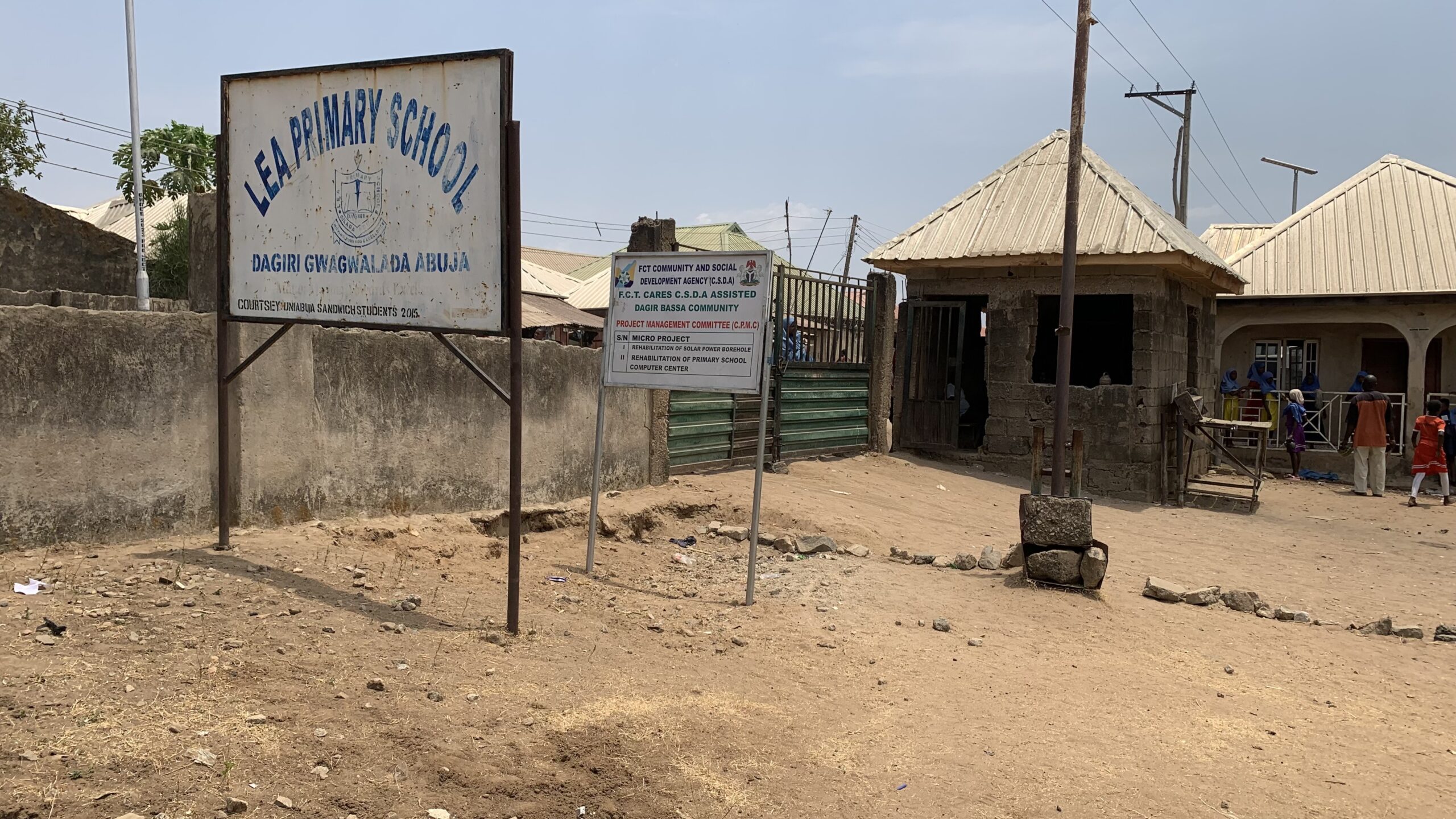
Blog Category: Technology
At the Local Education Authority (LEA) Primary School, Dagiri, a community in the university town of Gwagwalada on the outskirts of Abuja, pupils sit on wooden chairs inside a classroom. When the pupils look up, they see that parts of the inner ceiling of their classroom have fallen off, and the rest hang loosely, threatening to collapse. It is not the school environment you expect to find in one of the six area councils of the Nigerian capital.
However, the damaged ceiling is arguably one of the Abuja school’s smallest problems. The school has no toilet, so the pupils use the open ground behind the classroom blocks when nature calls, putting the health of pupils and staff at risk. Also, because they also have no functional playground, they have adapted to kicking about sand, laughing, and running around an open space in the schoolyard during break.
The school also lacks a sickbay or library, and the computer laboratory, meant to introduce the pupils to digital learning, is inadequately equipped.
Research shows that missing or non-functional facilities affect quality education. According to UNESCO, the physical school environment, including health services, libraries, and access to technology, plays a vital role in shaping student outcomes. It is the bedrock of an inclusive and effective learning experience.
The Dagiri school is one of hundreds of primary and secondary schools across Nigeria with dilapidated or inadequate infrastructure. Many of such schools also lack internet access.
UNESCO’s 2023 Global Education Monitoring(GEM) Reporthighlights that only 40 per cent of primary, 50 per cent of lower secondary, and 65 per cent of upper secondary schools globally have internet access for educational purposes, revealing stark inequities in digital infrastructure. UNESCO further notes that digital tools serve as key inputs for learning and planning and that their presence significantly impacts students’ performance, especially in under-resourced settings.
School health services are equally critical. A joint global reportby UNESCO and partners shows that school health and nutrition programmes improve enrolment and attendance increase by as much as eight to nine per cent when meals are provided. There is currently no school feeding programme for children in Nigerian public schools, although the government has pledged to restart the programme it suspended about two years ago.
In areas plagued by malnutrition and parasites, interventions like deworming can add up to 2.5 years of schooling.
Also, libraries, though often overlooked, are essential hubs for literacy development and independent thinking. They provide a quiet, resource-rich space where students can cultivate research skills, deepen their understanding of subjects, and develop a lifelong love for reading.
The Sustainable Development Goals (SDGs), specifically SDG 4, call for the provision of safe, inclusive, and effective learning environments, including access to electricity, computers, the internet, libraries, water, and sanitation.
Overall, the state of many of Nigeria’s public schools reflects the country’s failure to meet global standards for basic educational infrastructure.
When PREMIUM TIMES visited the Dagiri school in March, an uncompleted structure stood out behind the classrooms. Grass had begun to grow inside the plastered and partly roofed building, and parts of the roof’s wooden framework had collapsed.
“That building has been there for four years now,” the head teacher, Abubakar Sadiq, said. “I reported to my head office late last year that there is an abandoned building on the premises. They asked me to do a video and take a picture, which I did. They also came for inspection themselves, but nothing has been done till now,” Mr Sadiq explained.
PREMIUM TIMES also observed that the computer laboratory was too small for a full class of pupils and poorly equipped to serve their needs. The laboratory’s head, Halima Ibrahim, described how the inadequacies had contributed to the challenges of digital learning in the school.
She said that because the computers were insufficient, students had to work in groups and take turns just so each could “have a feel of it.” She added that the few available systems were ageing and unreliable. Many no longer retain battery power, making them unusable.
“Having a computer lab is very important for children; they are always happy to come here because of their curiosity,” she said.
According to the headteacher, the school has over 1,800 pupils — including 711 boys and 806 girls in the primary section, and 133 boys and 154 girls in the nursery.
In many parts of Nigeria, children are learning in classrooms that fail every standard of safety and functionality.






0 comment(s)
Leave a Comment