 Author: Subsidy, that toxic girlfriend that must never come back even at $200 dollar oil. Posted On: 13 hours ago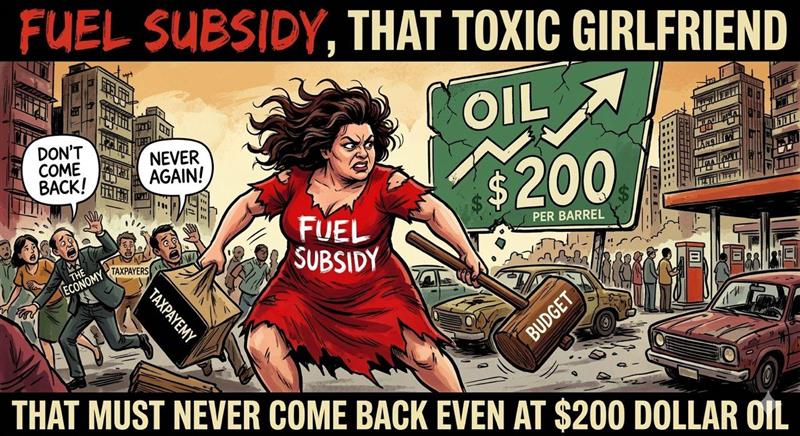
Blog Category: Academics
There is a category of ex you don’t just break up with, you block, delete, mute, and spiritually excommunicate from your life.
No follow requests accepted, no 2am calls entertained, no “I’ve changed” speeches tolerated.
Nigeria and fuel subsidy need that kind of separation.
Permanent. Irreversible. Non-negotiable. And the conversation we had on Drinks and Mics this week, along with the comments that kept rolling in afterwards, made clear that not everyone has arrived at this conclusion yet. So let’s settle it.
We love to point fingers at Abuja whenever the subsidy conversation comes up, and honestly, Abuja deserves many of those fingers. But let me tell you something that stuck with me from a recent conversation.
A friend of mine recently switched his company’s fleet to BYD electric vehicles. We were standing outside admiring the cars when he mentioned, almost in passing, that his fleet team had been refilling pool vehicles at ₦95,000 per tank. The problem?
A full tank for those vehicles shouldn’t cost more than ₦60,000. That’s ₦35,000 being quietly pocketed on every single fill, across a fleet of over 100 vehicles, for years. Nobody held a press conference about it. Nobody was indicted. It was just business as usual.
The BYD, by the way, gives close to 600km on a full charge, Lagos to Ibadan, three times over, and charges in 2 to 3 hours. The theft stopped the day the pump was replaced by a plug.
That story isn’t about government. It’s about us. Subsidy in Nigeria doesn’t just enable corruption at the top, it franchises it downward, all the way into your office car park, your domestic staff, your supply chain.
It creates a national architecture of incentivized dishonesty, where the gap between the subsidised price and the market price becomes everybody’s personal business opportunity. The man signing the NNPC contracts and the driver submitting inflated fuel receipts are operating from the same playbook. The scale differs; the instinct doesn’t.
Every time petrol prices rise, someone shows up in the comments with the phrase: “We are an oil producing country, cheap fuel is our right.”
It’s an emotionally satisfying argument. It is also economically illiterate.
Here is the cost reality. Saudi Arabia’s average cost to produce a barrel of oil is among the lowest in the world, typically under $10.
The UAE’s breakeven sits just above $20. Nigeria’s after-tax breakeven for producing fields is probably $30+ per barrel. And that’s before you layer in the cost of crude theft, pipeline vandalism, years of underinvestment, and a creaking infrastructure that haemorrhages oil before it ever reaches a refinery.
So when oil is trading at $75 a barrel, Saudi Arabia is pocketing the better part of $65 on each barrel. They can sell crude to their domestic refineries at $25, subsidise pump prices, and still run a surplus.
They are not subsidising fuel, they are discounting their profit margin. That is a fundamentally different thing.
Nigeria doesn’t have that luxury. At $30+ to get the oil out of the ground, and that’s on a good day when the pipeline isn’t vandalised, and someone isn’t stealing barrels at the wellhead, the margin for generosity is thin to non-existent. Needless to say, the government is also broke. Giving away cheap petrol in this environment isn’t a social policy. It’s a fiscal suicide note.
And if the response is “but let’s give Dangote cheaper feedstock so he passes savings to consumers”, that Pandora’s box should stay sealed. Give someone a $10 discount per barrel in Nigeria and I guarantee you, $10 will appear somewhere as a kickback before the crude hits the refinery gate.
We lack the institutional infrastructure to manage a sensitive subsidy mechanism without it becoming a feeding trough. That is not cynicism, it is pattern recognition.
Let’s take a walk across the West African corridor, because the regional data makes the argument more powerfully than any op-ed can.




0 comment(s)
Leave a Comment