
Blog Category: Academics
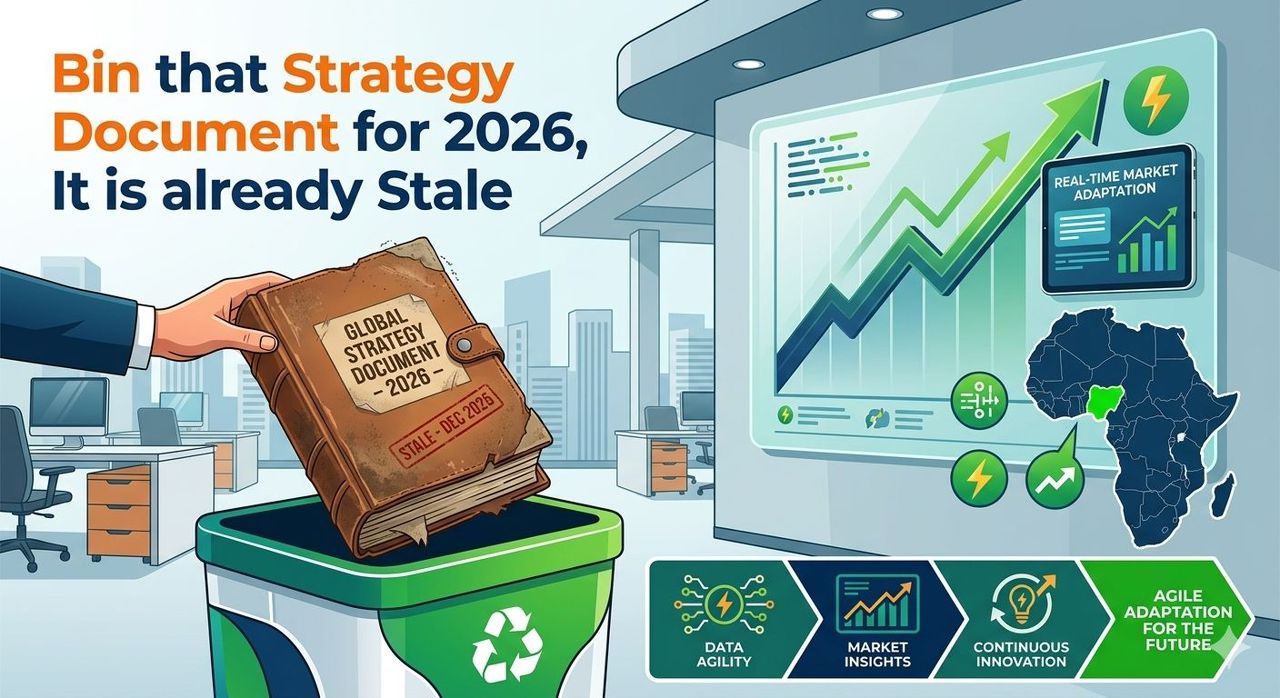
If you still have those elaborate “Strategy 2026” slides from your year-end retreats, do yourself a favor: throw them in the bin.
They are stale, irrelevant, and frankly, dangerous to hold onto.
The world has shifted on its axis, and the dimension we are moving into requires a total redraft of expectations.
I remember our early Drinks and Mics sessions where we sat around and debated the year ahead. We agreed then that the overriding theme for 2026 would be Geopolitics. At the time, it felt like a safe, intellectual bet. Today, it’s a brutal reality.
Back then, we called for a 70% return on the Nigerian Exchange (NGX), betting on declining inflation and the eventual scope for rate cuts.
That play was looking solid until the first missiles flew. Now, unless the US-Iran conflict finds a ceasefire that actually sticks (beyond the fragile whispers we’re hearing about the Hormuz Straits), every asset class is being repriced.
Sam, “The Oracle,” made the call that felt like a hedge but turned out to be the prophecy: 2026 is the Year of Oil, Hydrocarbons, and Gas.
The escalation between the US and Iran hasn’t just nudged the price of a barrel; it has fundamentally fractured the global energy nervous system. We aren’t looking at a temporary price hike; we are witnessing a synchronized failure across refining, extraction, maritime logistics, and terminal distribution.
This isn’t a light switch you can just flip back on once the missiles stop flying.
Global energy infrastructure is an ocean liner, not a speedboat; restarting it is a gruelling, capital-intensive process that requires the stability the world no longer possesses.
Look at the damage done to Qatar that would take years to restore, or how soon can you build back energy storage? 18-24 months? We have a serious lag that is yet to play out fully.
Europe serves as a grim masterclass in what happens when political virtue-signalling outpaces mechanical reality. For a decade, the continent pursued a “Net Zero” agenda with a zealotry that bordered on the suicidal. They didn’t just transition; they demolished.
They decommissioned world-class refining capacity and mothballed nuclear baseloads, most notably Germany’s decision to kill its nuclear fleet in the teeth of a supply crisis. It was a spectacular act of strategic self-harm.
The unspoken premise of European policy was that the global market would always be a polite, reliable neighbor willing to fill the gap between their green ambitions and their physical needs.
That neighbor has moved out. Now, the very nations that once orchestrated global trade through colonial might find themselves as “sitting ducks,” unable to secure the fuel required to keep their lights on at a sane price. There is a profound, almost poetic irony in seeing former empires rendered immobile because they forgot that moral authority cannot power a blast furnace.
Canada mirrors this decline. It is a nation essentially “sitting on a goldmine” but spending its energy convincing the world it has no interest in digging. By shackling its vast resource wealth in a web of regulatory purgatory and political hesitation, it has left itself dangerously exposed.
The harsh truth of 2026 is this: Soft power is a hallucination without hard capability. Western powers are learning, with agonizing slowness, that being “right” on paper is no substitute for being “sovereign” in energy.
If Germany doesn’t stop over-intellectualizing its decline and start aggressively recycling its surpluses into industrial and energy hardware, the window will slam shut. The era of treating energy policy as a philosophical debate is dead. It’s time for math, or it’s time for the dark.
”Yakubu Manage” is not a policy response: Bringing it home, using the aviation industry as a case study
In Nigeria, Jet A1 fuel went from N900 to over N3,000 per litre in the blink of an eye. That’s not a “price adjustment”; it’s an industry-wide cardiac arrest.



0 comment(s)
Leave a Comment