

 Follow Us on Google
• Lauds Mbah for encouraging creatives
By Christian Agadibe
Tellingthe story of South-East Nigeria through art is no small task, but Sunday Chikaodinaka Chukwu does it with striking clarity. Drawing deeply from Igbo heritage, he weaves the philosophy of his people into carefully carved works, where meaning often hides in short, powerful proverbial expressions. His spellbinding pieces captured attention at the just-concluded four-day South-East Vision 2050 summit in Enugu, an event attended by the Vice President and the five South-East governors.
As conversations around the future of the South-East gathered momentum, Sunday Chukwu found himself not just observing but participating with quiet conviction.
“I feel so excited,” he said, reflecting on the South-East t Vision 2050 gathering. For him, the event was more than a high-level policy meeting. It was a rare moment when serious thought was being given to how the region can shape its own development story.
As both a gallery owner and a practising artist, Chukwu sees himself as part of that conversation. The creative sector, he believes, must not sit on the sidelines while economic and political plans are being drawn.
“I want to lend my voice,” he explained. “Not just for the creative sector generally, but especially for the visual arts and the space I occupy.”
For Chukwu, art is not decoration. It is documentation. It is identity. It is philosophy carved into form.
“We should use our art to tell our stories,” he said. “If you don’t tell your story, nobody will.”
His concern is simple but urgent. If a person does not define themselves, others will define them, often inaccurately. And that leads to what he calls “discordant tunes” when conversations turn to identity and heritage.
The answer, in his view, is intentional storytelling through art. Galleries and cultural spaces should become places of encounter, where visitors do more than admire objects. They should leave with insight.
Tourism, he argues, must go deeper than cuisine and commerce. “When people come to the Southeast, they shouldn’t just come to eat food you can find anywhere else,” he said. “They should go to places where they can learn who we are, what drives us, what philosophy shapes us.”
He points to the well-known saying about the Igbo being present almost everywhere in the world. That entrepreneurial spirit, that restless drive, did not appear by accident. It comes from a history and worldview that deserve to be preserved and presented with care.
Chukwu is proud to contribute to that effort through his latest exhibition at the summit. Although he runs his own gallery space, he said this particular platform felt different.
“I’ve been working in my studio for a long time,” he noted. “I’ve never really looked for a particular space to exhibit this kind of work because of the story I tell. But there’s no better place than here.”
For him, the setting aligns with the message. As leaders and stakeholders map out the region’s future, his carvings quietly stand nearby reminding everyone that development is not only about infrastructure and industry. It is also about memory, meaning, and the courage to tell your own story.
At his gallery at 685 Valley Crescent, Independent Layout, Enugu, the work does not just sit on pedestals. It speaks.
“When people come into the show, I take the opportunity to tell them who we are as a people through the works on display,” Chukwu said. For him, every visitor is a student of culture, whether they realise it or not.
That is why he believes conferences like the summit should always run alongside curated exhibitions. While policymakers debate development, artists should be interpreting identity just a few steps away.
“If we don’t tell authentic stories,” he warned, “people will come, stay two or three months, observe a few things, go back and shape the story the way it suits them. When they push it into the media, it becomes the story.”
Control the narrative or lose it. That is the quiet urgency behind his carvings.
The presence of the Vice President at the exhibition was, in many ways, symbolic. Chukwu admits he did not take it lightly.
“He’s the biggest guest that has come into this space,” he said. “And he’s very intentional about supporting everything that concerns the Southeast.”
When the Vice President arrived alongside the five Southeast governors, the moment felt bigger than the ceremony. It felt like recognition.
“It reaffirms that we have stories to be told,” Chukwu said. “All we need is the opportunity.”
Those stories, he explained, are rooted in Igbo cosmology and philosophy. Not abstract theories, but ideas preserved in short, sharp proverbs that once guided daily life. Before Western civilisation, he noted, Igbo communities functioned on deeply held ideals and value systems that ensured order and peace.
Today, many of those proverbs are fading. “In those days, if your father wanted to advise you, he would give you a proverb,” he recalls. That proverb creates a mental picture to help you solve the problem. Proverbs were tools to surmount challenges.”
His response is preservation through sculpture. When he titles a work with a proverbial expression, he is archiving language in metal and wood. Long after both artist and audience are gone, the proverb remains attached to the form.
“These works will outlive us,” he said. “If the title survives, anyone who understands the language can interpret the message.”
Asked which of his pieces he cherishes most, he hesitates.
“I don’t have the best work,” he said. “I work as a messenger. When the spirit gives the message, I deliver it.”
Still, some works carry deeply personal meaning. One is “Mama Ejima,” created to honour his wife, the mother of two sets of twins. The first set were girls. When the second pregnancy was confirmed as twins again, he admits he felt both joy and confusion. Instead of fear, he turned that emotional energy into art.
“I decided to exalt women,” he said. “She takes care of four children. That is power.”
The Vice President lingered at the “Mama Ejima” piece during his visit. For Chukwu, that attention felt affirming. Another important work is “Umuada,” inspired by the traditional women’s institution in Igbo society. He contrasts it with imported models of feminism, arguing that indigenous systems already carried their own balance and authority.
“Our women had sacred roles,” he said. “We had structures. We had ideals.”
Chief Sunday Chikaodinaka Chukwu, recently conferred with the chieftaincy title Omenka One of Nnume Unateze in Nkanu, was born in the North and educated across Nigeria. He studied at the University of Benin and later pursued advanced studies at the University of Nigeria, Nsukka, and Nnamdi Azikiwe University, specialising in Fine and Applied Arts. He lectures Sculpture at the Institute of Management and Technology in Enugu.
Art, for him, was not the default expectation. Like many gifted students, he began as a science student. But he describes his work today as “grown-up play” guided by intuition and attentiveness.
“A ritual,” he said with a smile, “can simply be quiet time. Being open, being happy enough to receive a message.”
He dismisses the old belief that art cannot put food on the table.
“It does,” he said plainly. “But I don’t create because I want to sell. I create because I have a message to deliver.”
His wife, a fashion designer and his childhood friend, shares that creative spirit. They met as teenagers in the North. Years later, they chose each other deliberately. Today, he speaks of her with the same pride he reserves for his sculptures.
Would he advise young people to study art? “Yes,” he said firmly, adding, “When a child is creative, don’t try to reprogram that child. Children come with different factory settings.”
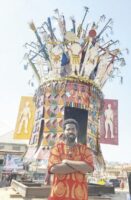
He credits the Enugu State governor for providing platforms for creatives. One of his most public works, the Ijele Masquerade sculpture installed at Onoh Asata, was commissioned by the state government. The project remains one of his most memorable milestones.
“When they came to my studio and said I was the one for the project, I poured my heart into it,” he said. Built in metal, the sculpture has endured public scrutiny and praise. Two years on, strangers still approach him in public to say, “You did that piece.”
But his vision stretches further.
He imagines a future Enugu where art auctions attract global collectors, where families choose galleries over bars on weekends, where trained tour guides tell layered stories about coal mines, rail lines, and nationalist thinkers.
He mentions figures like Nnamdi Azikiwe and Kwame Nkrumah, not as distant names in textbooks but as intellectual ancestors whose ideas shaped nations. He points out that many Nigerians travel abroad to see Igbo artefacts in foreign museums, sometimes explained by non-African curators, while neglecting the heritage sites in their own backyard.
“That has to change,” he said.
For Chukwu, development is incomplete without cultural confidence. Infrastructure matters. Policy matters. But so does the story.
“If we don’t train people to tell who we are,” he said, “others will observe one or two things from the city centre and go back to write our story for us.”
In the end, he does not measure his journey in highs or lows. The visit of the Vice President does not redefine his purpose, just as quieter days never diminished it.
“There was never a down time,” he said. “My mission is simple. Deliver the message.”
And in studio corners and exhibition halls, through proverbs cast in enduring form, he keeps doing just that.





0 comment(s)
Leave a Comment