
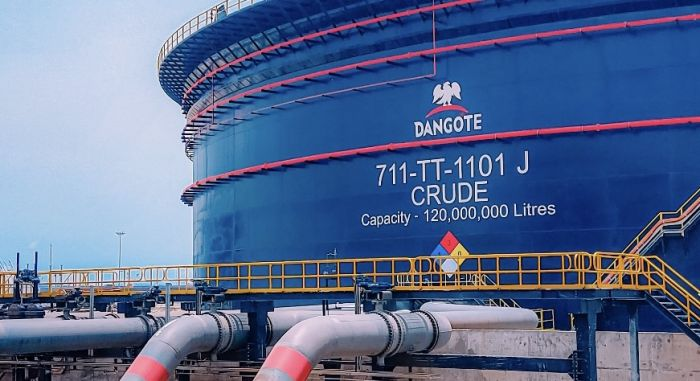
Dangote Petroleum Refinery has refuted claims that petroleum products exported from its facility are being re-imported into Nigeria through the offshore ship-to-ship trading hub in Lomé, Togo.
The refinery disclosed this on Tuesday, June 23, through a statement issued by its management, describing the allegation as a “web of falsehoods” and insisting that the claim is not supported by available trade flows or commercial logic.
The rebuttal comes after reports emerged claiming that refined petroleum products exported by Dangote Refinery were finding their way back into Nigeria through the offshore ship-to-ship (STS) trading hub in Lomé.
What Dangote is saying
However, Dangote Refinery strongly refuted the claim, arguing that the allegation is not “supported by either available trade flows or commercial logic.”
Other News
The company outlined four reasons why it believes the allegation is unfounded, ranging from its commercial objectives and the economics of the trade to its compliance procedures and long-standing advocacy for local refining.
According to the refinery, facilitating the re-importation of its own products would run contrary to its objective of strengthening its position as a leading supplier of petroleum products to the Nigerian market.
It also argued that the economics of such a trade do not make sense.
- “The estimated logistics cost of moving products from Dangote Refinery to Lomé and subsequently back into Nigeria is approximately US$82–90 per metric ton. These additional costs would significantly erode margins and make such transactions commercially unattractive.
- “Furthermore, Dangote Refinery does not offer export discounts of a magnitude that would offset these logistics costs or create a viable arbitrage opportunity between export and domestic markets.
- “Simply put, there is no evident commercial incentive for a producer to incur additional shipping, storage, financing and handling costs only for the product to return and compete in its largest and closest market,” the company stated.
Dangote further maintained that it has consistently advocated reducing Nigeria’s dependence on imported petroleum products, noting that increased imports undermine local refining, place pressure on foreign exchange reserves and weaken domestic industrial development.
Get up to speed
The claim that Nigeria is importing fuel originally exported by Dangote Refinery was attributed to Matthew Tracey-Cook of S&P Global Commodity Insights during a webinar organised by the Major Energy Marketers Association of Nigeria (MEMAN) last Thursday.
According to reports, Tracey-Cook said that while Dangote Refinery had increased supplies to the domestic market, marketers were also sourcing products through Lomé.
- “Dangote volumes on a coastal basis do arrive back in Lagos from Lomé,” he was quoted as saying.
- “For several months, from March until May, we saw well over 70-80% of the volume that were imported into Nigeria actually originated from Dangote; from their coastal Dangote volumes which were re-imported,” he added.
Responding, Dangote said the refinery “maintains comprehensive records of all product sales, including lifting locations, nominated vessels, counterparties, and destination declarations where applicable.”
- “Any suggestion that the refinery is knowingly facilitating re-importation is inconsistent with the contractual restrictions imposed on buyers and the refinery’s established compliance procedures,” the statement added.
What you should know
The controversy comes as Nigeria’s petrol imports rose sharply in May 2026 despite increased domestic refining capacity.
- Data from the Nigerian Midstream and Downstream Petroleum Regulatory Authority (NMDPRA) showed that average daily imports of Premium Motor Spirit (PMS) increased by 59.5% to 5.9 million litres per day in May, up from 3.7 million litres per day recorded in April.
- The increase suggests that marketers continued to supplement local supplies with imported products to meet market demand.
- However, domestic refineries remained the dominant source of petrol supply during the month, contributing 41.5 million litres per day compared to imported volumes of 5.9 million litres per day.
This means that locally refined petroleum products accounted for nearly 88% of the total petrol supplied across the country in May, underscoring the growing role of domestic refining in Nigeria’s fuel market.






0 comment(s)
Leave a Comment