
Blog Category: Academics
*NECA: With $25bn unaccounted for NNPC, new MOU unpatriotic
*Canvasses refineries’ privatisation or concessioning
*Report: NNPC’s new MoU carries too many risks
Emmanuel Addeh in Abuja and Dike Onwuamaeze in Lagos
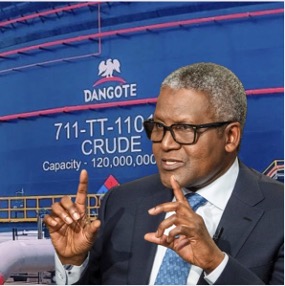
Aliko Dangote, Africa’s wealthiest industrialist, has stated that he is eyeing Kenya as the site of a huge $17 billion 650,000-barrel-a-day oil refinery he plans to build in east Africa, after questions over a previous push to build the facility in Tanzania.
Tanzanian President Samia Suluhu Hassan last week complained angrily to her Kenyan counterpart William Ruto that she had not been consulted over the earlier plan to build it on her country’s coastline, which was announced in her absence last month at an infrastructure summit.
“I’m leaning more towards Mombasa because Mombasa has a much larger, deeper port,” he told Financial Times in an interview. He compared Kenya’s port to Tanga, the proposed Tanzanian site for the refinery to process oil from Uganda and the open market. Dangote estimated it would cost $15 billion to $17 billion to build.
“Kenyans consume more. It’s a bigger economy,” he said, adding that crude oil for the refinery could be transported by ship and need not be located near a pipeline that will carry oil nearly 1,500 kilometres from Ugandan oilfields to the Tanzanian coast at Tanga.
“The ball is in the hands of President Ruto,” he said. “Whatever President Ruto says is what I’ll do,” the Nigerian billionaire added
For the east African refinery to get off the ground, Dangote said, he would need Ruto to offer land, some east African finance and, most important, protection from what he called dumping of cheap fuel from the likes of Russia or India.
“There is no refinery in the world that can survive without that protection,” he said. “If we have an agreement, we can start this year,” he explained. He told the FT he could still build the refinery in Tanzania “if they are able to sort themselves out”.
Dangote’s Nigerian refinery was built over 10 years entirely in-house, defying critics who doubted he could ever get it up and running after decades in which the Nigerian state had tried and failed to build meaningful refining capacity.
“Dangote feels vindicated, not only by succeeding technically in getting the refinery to work, but also succeeding commercially,” one Dangote executive said, speaking on condition of anonymity.
The plant, the biggest so-called single-train refinery in the world at 650,000 barrels a day, has hit full capacity just when other countries are struggling to access petrol, diesel and jet fuel because most ships cannot transit the Strait of Hormuz.
Unlike several other African countries, such as Mauritius, Ethiopia and Zimbabwe, which have had to ration fuel or dilute it, Nigeria has seen no lines at petrol stations and has not had to take emergency measures.
Dangote’s refinery has been able to divert jet fuel, at hefty premiums, to European airlines scrabbling for supplies to keep flying. He has also prioritised sales to Ethiopian Airlines, by far Africa’s most important carrier, with a network that covers the entire continent.
The Dangote refinery is also a big exporter of urea fertiliser to the rest of the continent, with Nigeria absorbing only a fraction of its 3mn-tonne annual capacity.
The Iran war, and the resulting closure of the Strait of Hormuz, has been “payday” for Dangote’s business, according to the senior executive, who said fertiliser prices had doubled and margins on jet fuel widened significantly.
Dangote told the FT: “You can see all the other oil companies, their profitability has doubled. So you don’t expect us to do less.”
Kenya’s president has been fulsome in his praise of Dangote, saying that the Nigerian industrialist, the richest man in Africa, has demonstrated that Africans can build their own mega-projects.
“Nigeria has been a producer of oil for all the years that we know,” he said of Africa’s most populous country. “Yet, when you went to Nigeria, there were queues of people looking for fuel in petrol stations . . . until one African stepped forward and built a refinery,” he stated.
Dangote has made his fortune selling salt, sugar, flour, cement and now petroleum products by persuading successive Nigerian governments to give him tax breaks and favoured access to foreign currency as well as protecting his business from import competition.
Dangote said he was already pressing ahead with plans to more than double the capacity at his Lagos refinery to 1.4 million bpd. In 30 months, he said, he would have the equivalent of 10 per cent of US refining capacity and would be neck and neck with Reliance Industries, Mukesh Ambani’s company, which also refines about 1.4 million bpd.
“We’ll be price movers in the market,” Dangote said, adding that it was incumbent on Africans to invest in their own continent. “If we don’t, who else will?” he told FT.
NECA: NNPC’s Signing of Another MoU Unpatriotic
Also, the Nigeria Employers’ Consultative Association (NECA) has expressed grave concern regarding the recent announcement to revamp the Port Harcourt and Warri petroleum refineries, warning that it will be unpatriotic to clap for another MoU while about $25 billion from past revamps produced almost zero result.
It advocated that the Nigerian National Petroleum Company Limited (NNPC) should either privatise or concession the refineries rather than embarking on endless Turnaround Maintenance (TAM).
NECA expressed these views yesterday following the Memorandum of Understanding (MoU) signed on May 4, 2026, between the NNPC and Chinese firms for the “Restart, Completion, and Expansion” of the Port Harcourt and Warri refineries.
The Director General of NECA, Mr. Adewale-Smatt Oyerinde, in a public statement titled “NECA to NNPC: Enough of ‘MOU Governance’ and Failed Revamps on Port Harcourt and Other Refineries,” said that while it is noted that the nation desperately needs functional refineries, however, it cannot ignore the decade-long pattern of billion-dollar rehabilitation contracts that have delivered zero sustained refining output.
“It will be unpatriotic to endorse another opaque deal while questions on past spending remain unanswered,” NECA added.
Oyerinde said that it is on record and apt to say that the nation cannot afford another trail of wasteful spending.
“In the last few years, $25 billion has been spent with zero value. Between 2010 and 2023, Nigeria expended over N11 trillion – approximately $25 billion – on refinery rehabilitation projects, maintenance, and turnaround programmes, yet the state-owned refineries remain significantly unreliable and non-functional.”
“The gamble of over $1.5 billion on the Port-Harcourt refinery in March 2021 is still fresh in the minds of Nigerians and despite purported claims of 90 per cent readiness by 2026, the facility has not been recorded to produce sufficient barrels of refined product on a sustainable basis,” he explained.
He recalled that since the 1990s, Port Harcourt Refinery has endured multiple “rehabilitation cycles” – 2000-2010, 2012-2015, 2016-2021 – and each circle involved billions spent on facilities that continued to deteriorate.
“While the intention might be right, it is, however, important for the NNPC to avail Nigerians sufficient informational explanation on status of past spendings and audits carried out on the refineries.
“What are the details of the ‘technical equity partnerships’ of the MoU? With past efforts at TAM riddled with delays, cost overruns, and repeated shutdowns, what are the guarantees and safety-nets to ensure the past does not repeat itself at the expense of Nigeria and Nigerians?” Oyerinde asked.





0 comment(s)
Leave a Comment