
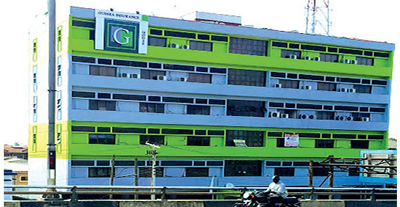
Guinea Insurance Plc’s shares have risen 42.86% in October, breaking eight consecutive months of declines despite the company reporting a bigger first-half loss.
The stock gained 10.5% in January, then fell every month from February through September, sliding from N1.47 to N0.70.
Its rebound to N1.00 at the close of trading on October 14 has narrowed its year-to-date loss to 24.81%.
The renewed buying comes despite its H1 2026 loss widening to N389.12 million from N114.72 million a year earlier, as claims rose much faster than income from insurance.
So, what is attracting buyers now?
Some brokerage firms believe the fresh money raised by Guinea has renewed hopes that it can grow and return to profit, while others point to investors buying after the earlier price decline.
But they agree with one thing: the company still needs to show that the new money can deliver better results.
Fresh funding gives investors a new story
Guinea’s recapitalisation provides the clearest development around which to examine the rally.
The company listed about 3.21 billion rights-issue shares at N1.10 each on September 28, followed by 6.31 billion private-placement shares on October 7.
The placement shares were issued at N1.45. Together, the listed shares represent about N12.68 billion at their issue prices and increase the share count to about 17.46 billion.
Vincent Oshioma of Blue Marina Securities identifies the announcement of the supplementary placement listing as a major catalyst for the rebound.
He said the rally may also reflect bargain hunting after the earlier price decline, while cautioning that “a low share price does not necessarily mean the company is undervalued”.
Investors who bought through the private placement paid N1.45 per share, while the stock closed at N1.00 on October 14 about 31% lower.
That gap may attract buyers who believe they are getting a bargain. But paying less than those investors did does not, on its own, make the stock cheap or guarantee that its price will rise.
Isaac Osaro, Head of Investment Research at First Securities Brokers Limited, believes investors are anticipating benefits that have yet to appear in earnings.
- “Our house view is that the October rally remains an expectation-driven trade rather than a confirmed earnings-led re-rating,” he said.
Put simply, investors may be buying the growth they expect from recapitalisation, rather than improvements already delivered.
Trading conditions may have magnified the buying
Rita Opara, Senior Research and Investment Analyst at Futureview Financial Services Limited, sees the rebound partly as relief following recapitalisation, amplified by relatively thin trading.
Opara’s analysis shows that more shares changed hands as the price rose. Daily trading averaged about 8.7 million shares between October 6 and 12, compared with 2.6 million in the second half of September. On October 9 alone, investors traded 13.6 million shares.
Even so, this was a small fraction of Guinea’s roughly 17.46 billion shares. Opara believes this helps explain how a relatively small amount of buying could push the price up quickly.
The price could also fall quickly if buying slows and more shareholders try to sell.
Claims remain the central earnings problem
The results show why brokers remain cautious. Income from insurance grew just 4.2% to N1.48 billion in H1, but the cost of claims jumped almost sixfold to N995.64 million.
For every N100 earned from insurance, claims cost about N67, compared with N12 a year earlier.
Other insurers sharing Guinea’s risks helped reduce the burden.
Even with that support, only N39.11 million remained after claims and other costs directly linked to its policies 91.4% less than a year earlier.
That was far short of the N852.65 million needed to run the company. Guinea reduced those running costs by 5.8%, but the savings could not make up for the sharp rise in claims.
Osaro’s assessment is that Guinea’s challenge extends beyond attracting more business: it needs to convert revenue into sustainable profits.
- Opara makes the same point more directly: “Capital doesn’t price risk. A bigger balance sheet won’t fix a claims problem.”
Additional funding can support larger policies. Those policies still need to earn enough to cover the claims and expenses they bring.
Investment income could help, but needs to become recurring
The new money gives Guinea an opportunity to earn more interest from bank deposits and investments while it works to improve its insurance business.
In H1, however, income from investments fell 10.3% to N249.51million. Increases in the value of its properties and financial investments helped bring the total investment result to N434.65 million. The N174 million property gain came from valuing the properties higher; it was not cash received from a sale.
Guinea’s cash balance rose to N3.95 billion in June, helped by N3.53 billion received for new shares. But running the business used up N548.74 million in cash during the period.
The company has more money available. What shareholders need to see next is whether it can use that money to earn steady income and make its insurance business profitable.
First Securities Brokers expects recapitalisation benefits to become more visible in Q4, 2026 or 2027. That remains an outlook, rather than an established earnings trajectory.
Valuation needs to reflect the enlarged company
The fresh funding also changes the question of whether Guinea’s shares are expensive.
At N1.00 per share, investors value the company at about N17.46 billion, including its newly issued shares.
Rita Opara of Futureview Financial Services Limited estimates that, after adding the money raised, the company could have roughly N17–N18 billion left after settling its liabilities.
On that basis, the share price may not look expensive compared with what the company owns.
But her estimate still needs to be confirmed by updated accounts, which will reflect fundraising costs and any further profits or losses.
What would justify the rebound?
Despite October’s gain, the N1.00 share price was still 24.81% below its end-2025 level of N1.33.
Investors who bought at that price have therefore recovered only part of their losses.
For the rally to last, Guinea needs to show that the fresh money is helping it make profits consistently, a point emphasised by Oshioma of Blue Marina Securities.
More insight
For now, Guinea’s rally appears to reflect hopes about what the fresh funding can deliver, bargain hunting and renewed buying around the listing of its new shares.
Its H1 results have yet to show the profit recovery needed to support those expectations.
Trading picked up as the price rose, but Futureview Financial Services Limited’s analysis shows that only a small fraction of Guinea’s shares changed hands.
This suggests relatively modest buying may have helped push the price up quickly.
Guinea Insurance now needs to explain how it will use the fresh money and show that it can grow the business while keeping claims and costs under control.





0 comment(s)
Leave a Comment