
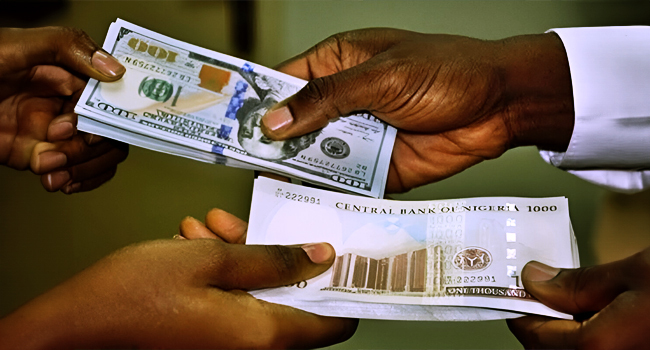
The naira depreciated against the US dollar at the Nigerian Foreign Exchange Market (NFEM) on Wednesday, closing at N1,361.5/$ compared to N1,356.5/$ recorded in the previous trading session, as foreign exchange market activity slowed significantly.
This is according to data published on Central Bank of Nigeria’s (CBN) website.
The data showed that daily turnover in the official market fell by about 57%, highlighting softer trading volumes despite sustained foreign exchange inflows.
What the data is saying
CBN figures indicate that the naira traded within a relatively narrow range during the session, while market turnover declined sharply.
Other News
- Intraday trading ranged between N1,357/$ and N1,361.5/$.
- The simple average exchange rate for the day stood at N1,360.13/$.
- NFEM turnover dropped to $54.29 million from $125.69 million recorded in the previous session.
- The number of completed deals declined to 74 from 125.
The sharp drop in turnover suggests reduced trading activity in the official foreign exchange market, even as the naira experienced moderate depreciation.
More insights
Global currency markets remained focused on developments in the United States and the Middle East, supporting demand for the US dollar.
- The US dollar hovered near a more than two-month high as investors increased bets on further interest rate hikes by the Federal Reserve.
- Markets have priced in a high probability of additional monetary tightening later in the year amid persistent inflation concerns.
- Geopolitical tensions in the Gulf also continued to support safe-haven demand for the dollar following renewed warnings by US President Donald Trump over Iran.
The stronger dollar environment has placed pressure on several emerging market currencies, including the naira.
Despite the slight depreciation in the exchange rate, Nigeria’s external reserves continued to strengthen, providing additional support for the foreign exchange market.
CBN data showed that the country’s external reserves increased to $50.89 billion as of June 16, 2026, reflecting sustained foreign currency inflows and improved reserve accumulation.
Higher reserve levels improve the CBN’s capacity to support market liquidity and enhance confidence in the foreign exchange market, particularly during periods of global uncertainty.
What you should know
Nigeria’s external reserves have maintained an upward trend in June 2026.
- Nairametrics earlier reported that the country’sexternal reserves increased by more than $1 billion during the first half of June.
- The steady build-up in reserves comes amid ongoing efforts by the monetary authorities to strengthen foreign exchange liquidity and improve market stability.
- Nairametrics previously reported that reserves declined from above $50.08 billion on March 12 to $49.61 billion by March 23, 2026.
- In January 2026, reserves increased by about $509 million within the first 22 days, reflecting improved foreign exchange inflows at the time.
Nigeria’s external reserves have strengthened significantly over the past year following foreign exchange reforms introduced by the CBN.






0 comment(s)
Leave a Comment