
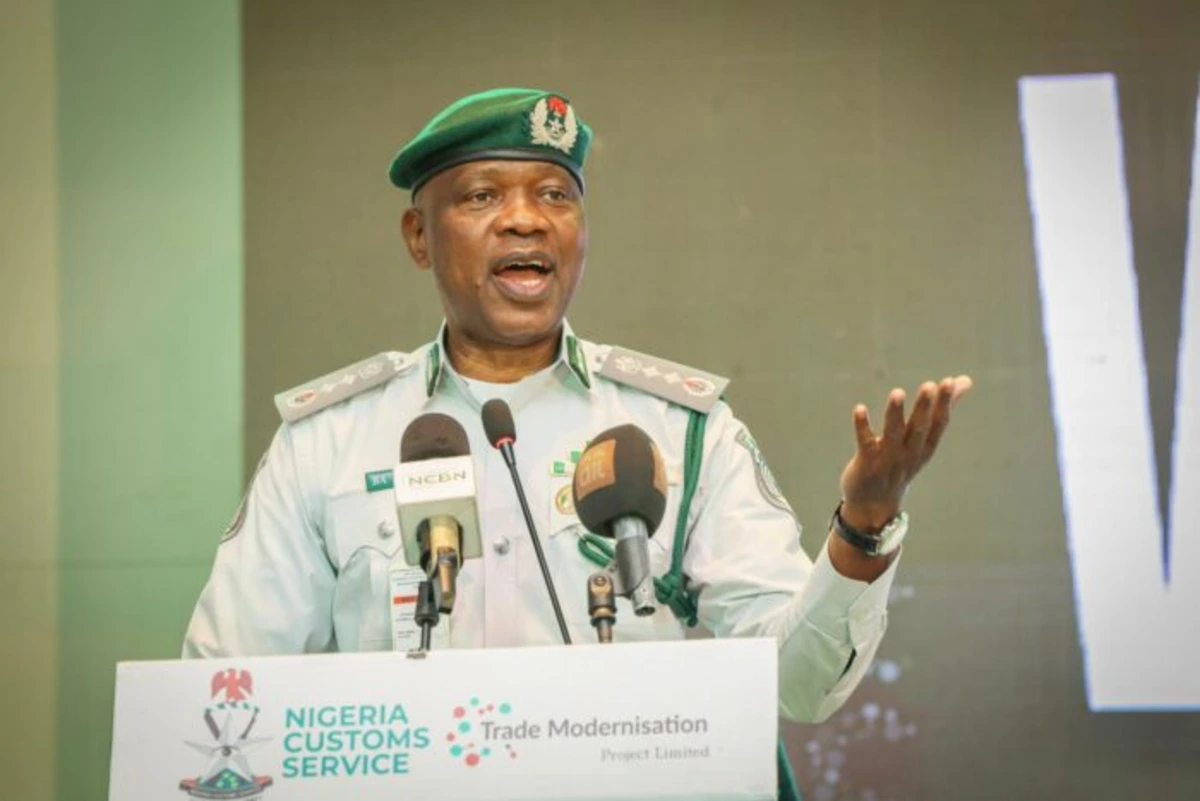
The Nigeria Customs Service generated N4.03 trillion in revenue in the first half of 2026, putting it significantly ahead of its mid-year projections and on course to meet its N11 trillion annual target, Comptroller-General Dr. Adewale Adeniyi has said.
Adeniyi made the disclosure in a compendium, attributing the performance to automation, intelligence-led enforcement, and the deliberate removal of human discretion from core customs processes, a reform he said was driving exponential revenue growth without hurting trade.
The first-half figure represents a significant jump compared to the same period in 2025, with the Comptroller-General saying the improved performance was anchored on replacing manual interventions with standardised rules, risk-based systems, and automated valuation references to block revenue leakages.
What the Comptroller-General is saying
Adeniyi said the decision to take discretion out of customs processes and replace it with technology has been the single most important driver of the revenue improvement.
Also Read
- “Modernisation within the Service is aimed at replacing officers’ discretion with standardised rules, risk-based systems, automated valuation references, and data-driven targeting to reduce vulnerability in customs operations,” he said.
- “We removed human discretion, deployed technology, and built trust with compliant traders. When you do that, revenue will grow exponentially without hurting business,” he added.
On the broader mandate of the Service, Adeniyi said customs has evolved beyond revenue collection into a multifunctional institution supporting trade facilitation, national planning, and border security simultaneously.
- “The Nigeria Customs Service is not just about collecting duties. We are facilitators of trade, generators of data for national planning, and gatekeepers against smuggling. Our job is to ensure that Nigeria’s borders work for Nigeria — for revenue, for security, and for prosperity,” he said.
The NCS has adopted Time Release Studies as a data-driven tool to measure and reduce cargo clearance times at ports and borders, with Adeniyi saying the approach is cutting delays, lowering costs for businesses, and improving Nigeria’s ranking in global trade facilitation indexes.
Intelligence-led enforcement has become the new operational standard for the Service, with the Comptroller-General saying the combination of geospatial intelligence, digital surveillance, and inter-agency coordination has transformed how the NCS approaches border security.
Get up to speed
The Nigeria Customs Service (NCS) projected a N11.074 trillion revenue target for 2026 as part of its budget proposal presented to the National Assembly in early July, following a strong revenue performance in 2025.
- The target is significantly higher than the N6.584 trillion revenue target for 2025, which the Service surpassed after generating N7.277 trillion during the year.
- The 2026 target comprises N5.542 trillion for the Federation Account, N1.491 trillion from non-Federation revenue, N2.773 trillion from Import VAT and N1.266 trillion from the four per cent Free-on-Board (FOB) levy.
- The target received legislative backing on July 8, 2026, when the Senate approved the NCS’s 2026 budget, including the N11.074 trillion revenue target and an expenditure estimate of N1.295 trillion.
However, Customs had already been working to strengthen revenue collection before the target received Senate approval.
The Service generated N3.35 trillion between January and May 2026, attributing the performance to stronger trade facilitation, improved customs processing and intensified border enforcement operations across the country.
The five-month performance was disclosed during a joint security news briefing organised by the Office of the National Security Adviser in Abuja.
What you should know
The Nigeria Customs Service is also pushing for a review of policies that could affect revenue mobilisation and the wider trade environment.
Earlier this month, the Service urged the National Assembly to review Nigeria’s import waiver and concession regime, questioning whether the incentives still justify their fiscal cost and remain aligned with the economic objectives for which they were introduced.
Adeniyi also called for a post-implementation review of the Nigeria Customs Service Act 2023, arguing that three years of implementation have provided enough experience to identify provisions that may require refinement as Nigeria’s trade environment evolves.




0 comment(s)
Leave a Comment