
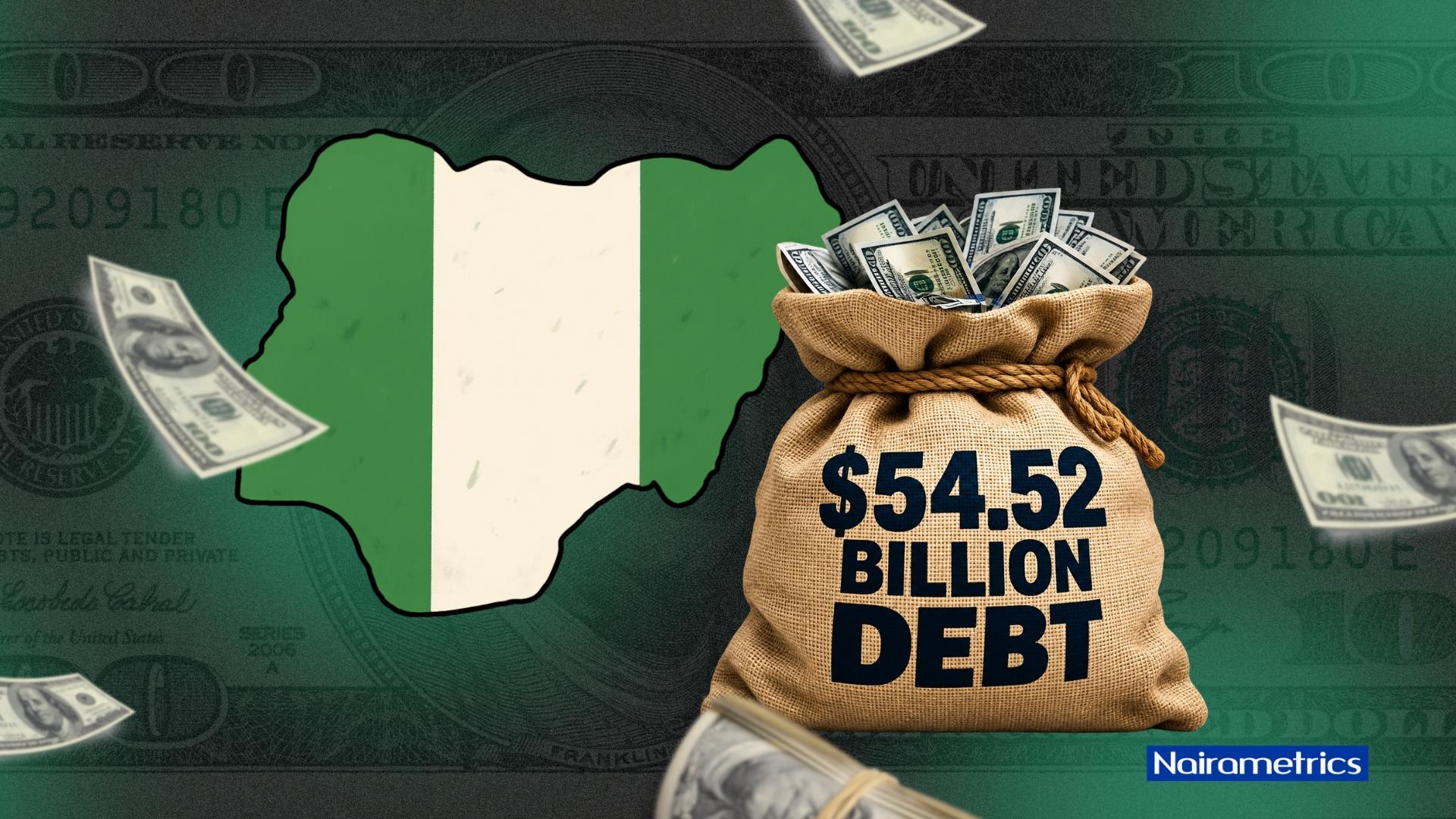
Nigeria’s external debt stock increased to $54.52 billion as of June 30, 2026, up from $51.90 billion at the end of March, as fresh financing from multilateral institutions, bilateral partners and syndicated lenders pushed the country’s foreign obligations higher.
Data from the Debt Management Office (DMO), analyzed by Nairametrics Research, shows that Nigeria’s total external debt stood at $54.52 billion as of June 30, 2026, up from $51.90 billion in March 2026, adding $2.62 billion during the three months to June.
This represents a 5.05% quarter-on-quarter increase.
However, the external debt stock increased from $45.98 billion in March 2025 to $51.90 billion in March 2026, representing a 12.90% year-on-year increase, equivalent to almost $5.93 billion in additional external obligations.
What the data is saying
A closer look at the data reveals that Nigeria’s top 10 creditors accounted for $53.06 billion or 97.32% of total external debt, underscoring the concentration of the country’s foreign obligations among a limited group of lenders and investors.
The International Development Association (IDA), the concessional lending arm of the World Bank Group, remained Nigeria’s largest individual external creditor as of June 2026, accounting for 35.07% of total external debt, while Eurobond investors represent another 34.02%.
The World Bank’s International Development Association (IDA) and Eurobond investors alone accounted for 69.09% of the total external debt stock.
When the AfDB Group, ADF, and other multilateral facilities are included, multilateral institutions collectively represent the largest source of external financing for Nigeria.
Adding China Exim Bank takes the concentration to about 78.1%, while including AfDB and the combined First Abu Dhabi Bank exposure pushes the share above 87%.
This reflects the government’s preference for relatively cheaper and longer-tenor funding amid persistent fiscal pressures, widening infrastructure deficits, and recurring budget shortfalls.
10. China Development Bank — $573.53 million
Nigeria’s debt to the China Development Bank increased to $573.53 million as of June 2026, representing 1.05% of total external debt.
It increased by 13.01% quarter-on-quarter from $507.52 million and by 35.32% year-on-year from $423.83 million.
The increase reinforces China’s growing role in Nigeria’s external financing structure beyond its traditional Exim Bank exposure.
Taken together, China Exim Bank and China Development Bank accounted for 10.1% of Nigeria’s external debt as of June 2026.
9. AFREXIM Bank — $835.78 million
The African Export-Import Bank (Afreximbank) recorded outstanding exposure of $835.78 million in June 2026, representing 1.53% of total external debt.
The debt stock expanded significantly from $637.82 million in March 2026, reflecting a 31.04% quarter-on-quarter increase.
The lender has played a growing role in supporting trade finance, foreign exchange liquidity, energy infrastructure, and strategic economic interventions across Africa, including Nigeria.
8. France (Agence Française de Développement) — $906.23 million
Nigeria’s debt to Agence Française de Développement (AFD) stood at $906.23 million in June 2026, accounting for 1.66% of external debt.
The exposure increased by 0.45% quarter-on-quarter but was up by a substantial 46.59% year-on-year from $618.20 million in June 2025.
The sharp annual increase places France among the fastest-growing major bilateral financing partners in Nigeria’s external debt portfolio.
French development financing has supported areas including infrastructure, transportation, energy, climate-related projects and urban development.
7. African Development Fund — $1.01 billion
The African Development Fund (ADF), the concessional arm of the AfDB Group, maintained its position among Nigeria’s largest creditors.
Nigeria owed the fund $1.01 billion at the end of June 2026, accounting for 1.85% of total external debt.
ADF financing is generally targeted at development projects in lower-income African economies and offers more favorable financing conditions than conventional commercial debt.
6. International Bank for Reconstruction and Development — $1.61 billion
The International Bank for Reconstruction and Development (IBRD), another arm of the World Bank Group, was owed $1.61 billion by Nigeria at the end of June 2026, representing 2.95% of the total external debt stock.
The exposure increased by 12.14% quarter-on-quarter from $1.43 billion and rose by a significant 19.42% year-on-year from $1.35 billion.
The rise in IBRD borrowing is noteworthy because IBRD financing is generally less concessional than IDA financing.
Nigeria therefore needs to pay closer attention to the cost and expected returns of projects financed through this channel.
The increase also indicates that Nigeria’s World Bank exposure is not limited to concessional IDA financing; its obligations to the broader World Bank Group continue to expand.
5. African Development Bank — $2.17 billion
The African Development Bank (AfDB) remained one of Nigeria’s largest multilateral creditors, with outstanding debt of $2.17 billion as of June 2026.
The balance represented 3.99% of total external debt.
AfDB debt declined by 0.89% quarter-on-quarter, from $2.19 billion in March, but increased by 2.28% year-on-year from $2.13 billion.
The AfDB remains a key source of development financing, supporting agriculture, energy, transport infrastructure, climate resilience initiatives, and industrial development programmes across Nigeria.
For Nigeria, borrowing from the AfDB also provides access to development-oriented financing and technical expertise while reducing reliance on purely commercial lenders.
4. First Abu Dhabi Bank — $3.37 billion
A notable development in the Q2 2026 data is the increasing exposure to First Abu Dhabi Bank (FAB).
The DMO data show two separate FAB-related exposures: $1.87 billion under syndicated financing and $1.50 billion under an “Other Commercial” category described as a total return swap.
Taken together, Nigeria’s exposure to First Abu Dhabi Bank stood at approximately $3.37 billion, equivalent to about 6.19% of total external debt.
The syndicated exposure was unchanged from March 2026, while the $1.50 billion total return swap exposure emerged in the June data.
On a combined basis, the FAB exposure therefore increased by roughly 80% quarter-on-quarter, from $1.87 billion to $3.37 billion.
This development is particularly important because it shows the growing role of structured and syndicated financing in Nigeria’s external debt portfolio.
3. Exim Bank of China — $4.91 billion
China’s Exim Bank remained Nigeria’s largest bilateral creditor, with outstanding debt of $4.91 billion as of June 2026, equivalent to 9.01% of Nigeria’s total external debt.
China Exim Bank debt declined by 0.75% quarter-on-quarter from $4.95 billion in March but was marginally higher by 0.03% year-on-year compared with $4.91 billion in June 2025.
China’s importance in Nigeria’s debt portfolio extends beyond the size of the loan balance.
Chinese loans have traditionally financed large-scale infrastructure projects including rail networks, airport upgrades, power projects, and transportation infrastructure.
For Nigeria, borrowing from Chinese institutions provides access to financing for projects that would be difficult to execute solely from annual budgetary allocations.
Infrastructure borrowing can be beneficial when it improves productivity, reduces logistics costs and stimulates economic activity. But where projects generate limited direct revenue or broader economic returns, the government can be left carrying the repayment burden for years.
2. Eurobond — $18.55 billion
Nigeria’s second-largest external creditor exposure remains its Eurobond investors, representing the country’s international capital market borrowing.
As of June 2026, outstanding Eurobond obligations stood at $18.55 billion, unchanged from March 2026 but representing a 7.1% increase from June 2025.
Eurobonds accounted for 34.02% of total external debt, making international investors nearly as significant as the World Bank in Nigeria’s external financing structure.
Nigeria has historically turned to Eurobond issuances to finance budget deficits, support infrastructure development, and diversify funding sources beyond domestic borrowing.
The challenge, however, is that Eurobond debt is generally more expensive than multilateral loans and is highly sensitive to global interest rate conditions. Rising global borrowing costs could increase refinancing risks when existing bonds mature.
1. World Bank’s IDA — $19.12 billion
The International Development Association (IDA), the concessional lending arm of the World Bank Group, remains Nigeria’s largest individual external creditor as of June 2026.
Outstanding debt to the IDA rose from $18.39 billion in March 2026 to $19.12 billion in June 2026, representing a 3.99% quarter-on-quarter increase and a 6.0% year-on-year increase. The institution alone accounts for 35.07% of Nigeria’s total external debt stock.
The size of the exposure reflects Nigeria’s long-standing reliance on World Bank financing for development programmes and projects covering infrastructure, social protection, healthcare, education, agriculture, energy and institutional reforms.
IDA financing is particularly attractive because it is generally cheaper and has longer repayment periods than commercial borrowing. This makes it useful to a government trying to fund large development needs without immediately taking on the higher financing costs associated with market-based debt.




0 comment(s)
Leave a Comment